
Your Source for Industrial Electrical Expertise
JHL Industries manufactures and supplies professional-grade electrical products for contractors, warehouse operators, and industrial buyers — including heavy-duty extension cords, cable management systems, hook and loop fasteners, and industrial tapes.
Practical Expertise for Industrial Buyers
Selecting the right electrical products for industrial applications requires understanding load requirements, environmental conditions, safety standards, and product specifications that go well beyond a standard product listing.
JHL Industries maintains this Knowledge Center to provide contractors, warehouse operators, procurement managers, and distributors with accurate, detailed information — so every purchasing decision is grounded in performance data.
Our guides cover product selection, application-specific requirements, installation considerations, and maintenance practices across our full range of electrical and fastening products.
Buying Guides
Specification-based guidance to match the right product to your application, load, and environment.
Technical References
Wire gauge charts, ampacity ratings, UL standards, and industry code requirements explained clearly.
Application Notes
How electrical products perform across construction, warehousing, manufacturing, and commercial environments.
Safety & Compliance
OSHA requirements, UL listings, NFPA 70 considerations, and job site safety practices.
In-Depth Technical Resources
Detailed guides on product selection, installation, and maintenance for industrial electrical and fastening products.
Industrial Extension Cord Buying Guide
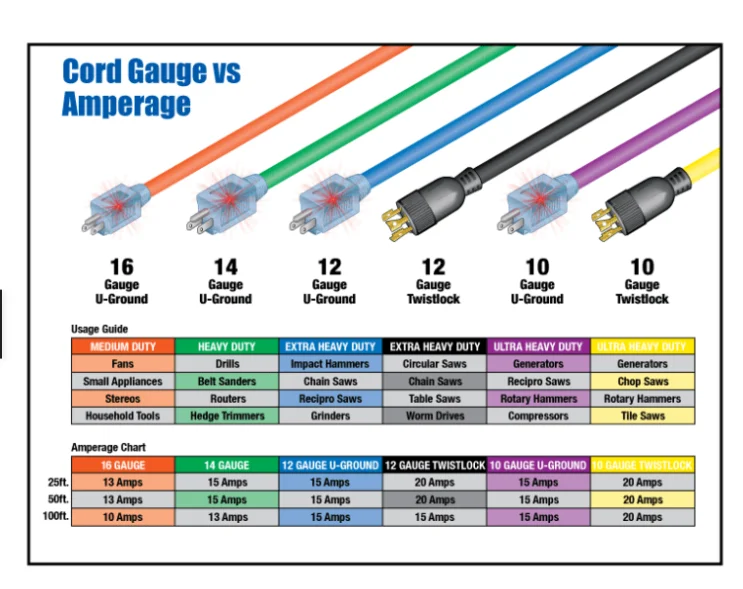
A complete reference for selecting heavy-duty extension cords based on wire gauge (AWG), ampacity, jacket ratings, cord length, and application environment. Covers SJTOW, SOOW, GFCI requirements, and locking plug configurations for professional job sites.
How to Prevent Extension Cord Damage on Job Sites
Extension cord failures are a leading cause of electrical fires on construction sites. Covers proper storage, protection from vehicle traffic, strain relief, inspection protocols, and retirement guidelines per OSHA requirements.
Cable Management Solutions for Warehouses
Warehouses with extensive conveyor systems and charging stations require systematic cable management. Covers cable trays, raceways, tie mounts, hook and loop cable wraps, and floor-level cable protectors for high-traffic environments.
Industrial Hook and Loop Fasteners Explained
Hook and loop fastening systems offer reusable, adjustable attachment solutions that outperform cable ties in applications requiring frequent access. Covers material grades, tensile strength ratings, temperature ranges, and UV resistance.
Choosing the Right Cable Ties for Heavy Loads
Breaks down tensile strength ratings (18 lb to 250 lb), material types — nylon 6/6, stainless steel, UV-stabilized — width and length selection, and mounting hardware options for specific bundle sizes and load requirements.
Electrical Tape Uses in Industrial Environments
Industrial electrical tape serves multiple functions beyond basic wire insulation. Covers voltage ratings, temperature ratings, self-fusing rubber tape for splices, color-coding standards for phase identification, and specialty tape applications.
Where JHL Products Perform
Industrial electrical products must perform across environments that vary in temperature, moisture, mechanical stress, and regulatory requirements.
Construction & Job Sites
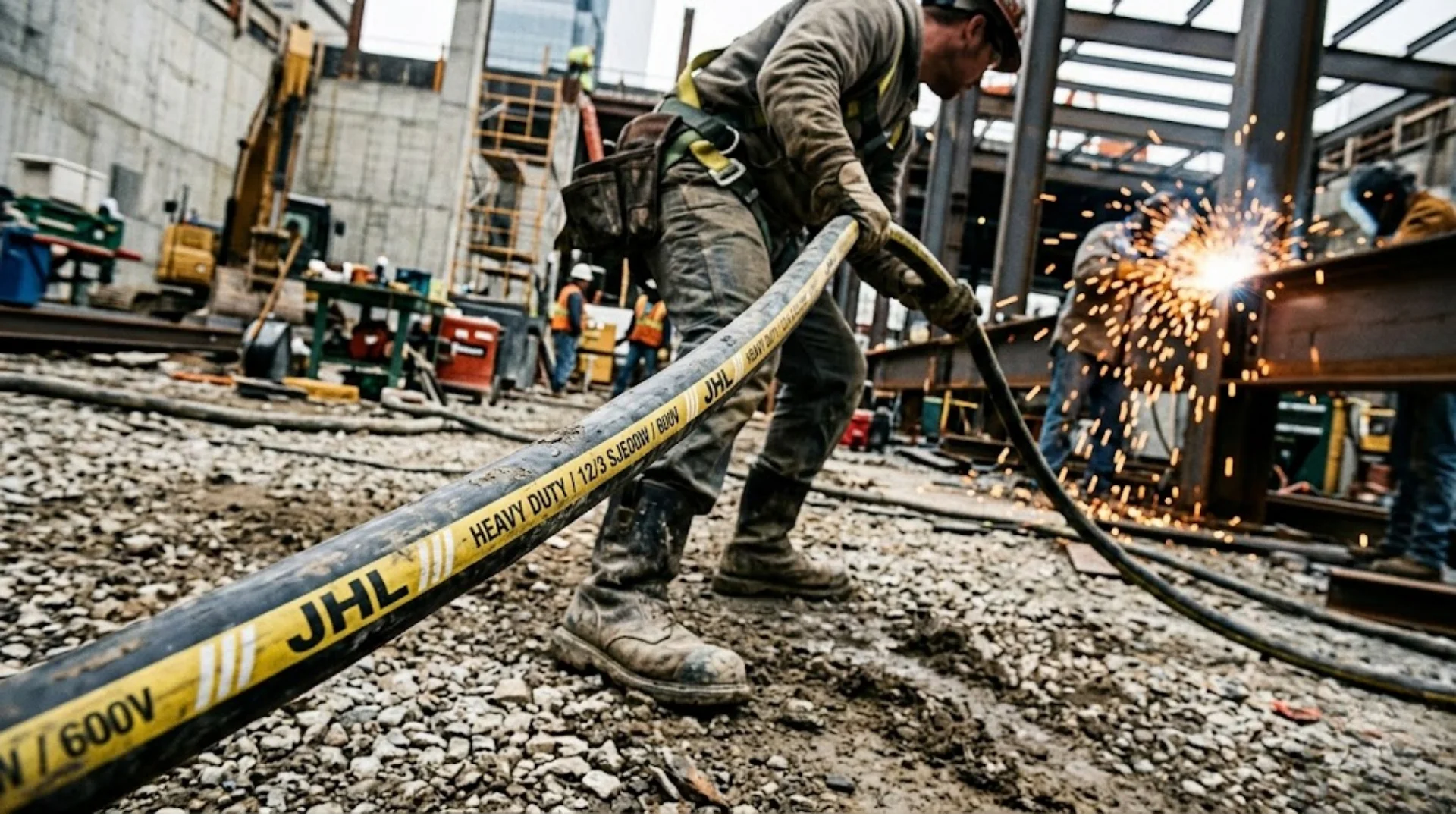
Active construction environments expose electrical accessories to physical abuse, moisture, and extreme temperatures. JHL's heavy-duty extension cords with reinforced rubber jackets (SOOW-rated), locking connectors, and GFCI protection are designed to perform through the full duration of a project.
Warehouses & Distribution Centers
Warehouse operations depend on organized, accessible power and data infrastructure. Hook and loop wraps, tie mounts, and raceways maintain clean cable runs along shelving, conveyor frames, and loading dock equipment to reduce maintenance time and safety hazards.
Manufacturing Facilities
Production environments require cable management that withstands machine vibration, chemical exposure, and elevated temperatures. JHL offers stainless steel cable ties, high-temperature electrical tape, and industrial hook and loop straps rated for demanding factory conditions.
Commercial Buildings
Commercial construction and retrofit projects require clean, code-compliant electrical installations. JHL's product range supports low-voltage wiring organization, equipment panel management, conduit labeling, and temporary power distribution during renovation work.
Common Questions
Select a product category to see relevant questions and answers.
Industrial extension cords feature thicker gauge wiring (10–12 AWG), higher amperage ratings (15A–20A), reinforced insulation resistant to abrasion, oil, and moisture, locking plugs, and GFCI protection. Household cords use thinner 16–18 AWG wire, carry lower amperage, and are not rated for outdoor or job site use. Using a household cord in an industrial setting creates both a performance and safety risk.
Construction sites require cords rated for outdoor use (the letter W in the jacket designation), with at least 12 AWG wiring for runs up to 100 feet and 10 AWG for longer runs. Look for SJTOW or SOOW jacket ratings, built-in GFCI protection, and locking plugs. Heavy-duty rubber jackets (SOOW) offer the best resistance to abrasion, temperature extremes, and job site chemicals.
For equipment drawing 15–20 amps, use a 12 AWG cord for runs up to 100 feet or a 10 AWG cord for runs up to 150 feet. For equipment drawing more than 20 amps, 8 AWG or direct hardwiring may be required. Always match the cord's ampacity rating to the equipment's nameplate current draw. Voltage drop calculations should be performed for any run exceeding 50 feet to prevent motor damage and overheating.
Safe length depends on wire gauge and load current. A 12 AWG cord safely carries a 15A load up to 100 feet; a 10 AWG cord extends that to approximately 150 feet. Beyond these lengths, voltage drop increases significantly, which can damage motor windings and overheat the cord. For longer runs, use a thicker gauge cord or install a temporary power distribution box closer to the work area.
Yes, but the cord must be rated for the generator's output amperage. Use a 10 AWG or 12 AWG cord rated for outdoor use (SOOW or SJTOW jacket). Never plug a cord into a generator indoors or in enclosed spaces. For whole-house or multi-circuit generator connections, use a properly rated power distribution box rather than daisy-chaining multiple cords. Always keep the cord fully uncoiled during use to prevent heat buildup.
These are jacket type designations. SOOW stands for Service, Oil-resistant jacket, Oil-resistant insulation, Weather-resistant — it uses a heavy rubber jacket rated for tough outdoor and oil-exposed environments. SJTOW stands for Service Junior, Thermoplastic jacket, Oil-resistant, Weather-resistant — a lighter-duty thermoplastic jacket suitable for outdoor use but less resistant to harsh chemicals and physical abuse than SOOW. For demanding job sites, SOOW is the professional standard.
Yes. OSHA 29 CFR 1926.404 requires GFCI protection for all 120V, 15A and 20A temporary power outlets on construction sites. This applies to extension cords used to power tools and equipment. GFCI protection can be provided by a GFCI-equipped cord, a GFCI outlet, or a GFCI circuit breaker. GFCI devices trip within 5 milliseconds of detecting a 4–6 milliamp ground fault — well below the threshold that causes serious injury.
The most effective warehouse cable management combines overhead cable trays for permanent runs (keeping cables entirely out of traffic zones), hook and loop wraps for bundles that need periodic access, standard cable ties for fixed bundles, and floor cable protector ramps wherever cables must cross pedestrian or forklift aisles. Color-coding with electrical tape or cable labels reduces troubleshooting time during maintenance.
Route cables along walls, overhead structures, or racking whenever possible. Where cables must cross walkways or work areas, use cable protector ramps rated for the expected foot or vehicle traffic. Bundle loose cables with ties or wraps to eliminate slack. Clearly mark cable runs with high-visibility tape or warning signs. OSHA 29 CFR 1926.416 requires that all electrical cords be arranged to prevent tripping hazards on construction sites.
A cable tray is an open support system (ladder, solid bottom, or wire mesh) that holds cables in a defined path — cables can be added, removed, or rerouted without cutting or pulling. A conduit is an enclosed tube through which cables are pulled — it provides greater physical and moisture protection but makes changes and additions much more labor-intensive. Cable trays are preferred for high-density industrial wiring where layouts change frequently; conduit is preferred for permanent installations requiring maximum protection.
NFPA 70B recommends annual inspections of cable tray systems and cable runs in industrial facilities, with more frequent checks (quarterly) in high-vibration or chemical-exposure environments. Inspections should check for: physical damage to cable jackets, overloaded trays, loose cable ties, corrosion on metal supports, and any cables that have been improperly rerouted. Damaged cable ties or wraps should be replaced immediately.
NEC Article 392 permits power and data cables to share a cable tray under certain conditions, but it is generally best practice to separate them. Power cables (especially those carrying variable-frequency drive outputs) can induce electromagnetic interference in signal cables. If separation is not possible, maintain at least 6 inches of physical space between power and data bundles, or use a solid divider between them within the tray.
For 120/208V systems: Black = Phase A, Red = Phase B, Blue = Phase C, White/Gray = Neutral, Green/Bare = Ground. For 277/480V systems: Brown = Phase A, Orange = Phase B, Yellow = Phase C, Gray = Neutral, Green = Ground. These are industry conventions — the NEC does not mandate phase color coding above 100V for conductors other than the grounded conductor. Establishing a consistent internal standard and documenting it is more important than following any specific scheme.
Industrial hook and loop fasteners bundle cables and hoses, secure tools to surfaces, mount panels and covers, and create adjustable, reusable attachment points. Unlike zip ties, they are fully adjustable and reusable — ideal for applications where cables need frequent repositioning, such as robotic workcells, data center cable trays, and equipment panels requiring regular access.
Yes. Outdoor-rated hook and loop fasteners use UV-stabilized nylon or polyester materials that resist degradation from sunlight, moisture, and temperature fluctuations. Look for products labeled UV-resistant or outdoor-rated. Standard indoor hook and loop will degrade faster under direct sunlight and weather exposure. Always verify the temperature range and UV rating before exterior installation.
Cable ties are permanent, low-cost, and provide very high tensile strength — ideal for fixed bundles that are rarely changed. Hook and loop fasteners are reusable, adjustable, and tool-free to open and close — ideal for bundles that need regular access or repositioning. Cable ties must be cut and replaced every time a bundle is opened; hook and loop can be opened hundreds of times without replacement. In dynamic environments, the labor savings of hook and loop typically outweigh the higher per-unit cost.
Standard nylon 6/6 hook and loop is rated to 230°F (110°C). Polyester versions can handle up to 275°F (135°C). For applications near heat sources — exhaust systems, industrial ovens, or high-current electrical panels — use polyester or aramid fiber-backed hook and loop rated for higher temperatures. Always check the manufacturer's temperature specification before installing near heat-producing equipment.
The most common cause of grip loss is lint, dust, or debris filling the loop side. Use a stiff-bristled brush, a fine-tooth comb, or compressed air to clear debris from the loops. For greasy or oily contamination, isopropyl alcohol on a brush can remove residue without damaging the nylon. Avoid solvents that swell or dissolve nylon. Once clean, the grip typically recovers to near-original performance. Most industrial-grade hook and loop is rated for 500–1,000 open/close cycles before measurable grip degradation.
For small bundles (under 1 inch diameter) such as data cables and instrument wiring, ½-inch wide wraps provide adequate hold. For medium bundles (1–3 inches), use ¾-inch to 1-inch wide straps. For large power cable bundles over 3 inches in diameter, use 1½-inch or 2-inch wide straps to distribute the load and prevent the strap from cutting into the cable jackets. Wider straps also resist creep better in high-vibration environments.
Select tensile strength based on bundle weight and expected dynamic loads. For light data cable bundles: 18–50 lb ties are sufficient. For medium power cable bundles: 50–120 lb ties. For heavy industrial bundles, hoses, or outdoor structural applications: 175–250 lb ties. In vibration-prone environments, size up — vibration applies repeated stress cycles that can fatigue ties rated at their maximum capacity. Use a tensioning tool rather than hand-tightening for consistent installation.
Natural (translucent white) nylon 6/6 cable ties are for indoor, dry, non-UV-exposed applications. Black cable ties contain carbon black, which provides UV stabilization — they are rated for outdoor use and direct sunlight exposure with a service life of 7+ years. In direct sunlight, natural nylon ties will become brittle and fail within 1–2 years. Always use black UV-stabilized ties for any outdoor, rooftop, or sun-exposed installation.
Use stainless steel cable ties when nylon will degrade: in temperatures above 230°F, in chemical or solvent environments that attack nylon, in marine/coastal applications requiring corrosion resistance (use 316 SS), in food processing facilities requiring FDA-compliant materials, or in applications requiring electromagnetic shielding continuity. 316 stainless steel ties resist chlorides and are required in offshore, marine, and swimming pool environments where standard 304 SS would corrode.
Cable tie length must accommodate the full bundle circumference plus enough tail to engage the locking mechanism. As a rule, use a tie at least 1.5× the bundle circumference. For a 2-inch diameter bundle (≈6.3 in circumference), use a minimum 9-inch tie. Consult manufacturer bundle diameter specifications — exceeding the maximum rated diameter reduces the tie's effective tensile strength and risks head failure at lower-than-rated loads.
Releasable cable ties are slightly lower in tensile strength than equivalent standard ties — typically 15–25% lower due to the release tab mechanism in the locking head. For most cable management applications, this difference is not significant. Releasable ties provide major labor savings in any installation where cables need periodic access or bundle contents change. They should not be used as structural supports or in applications requiring maximum rated tensile strength.
NEC Article 334 and NFPA 70 guidelines suggest securing cables at intervals not exceeding 4.5 feet for horizontal runs and 4 feet for vertical runs when used as primary support. For bundling purposes without primary support function, 12–18 inch spacing is standard practice for most industrial cable bundles. In high-vibration environments, reduce spacing to 6–8 inches to prevent bundle movement and cable abrasion at the tie contact points.
Industrial environments use several types: vinyl electrical tape (rated to 600V, −18°C to 105°C) for general insulation and color-coding; self-fusing rubber tape for high-voltage splices and waterproof connections; high-temperature silicone tape for areas near heat sources up to 260°C; and PTFE thread seal tape for pipe fittings and pneumatic connections. Selecting the wrong tape type for voltage, temperature, or environmental conditions is a common cause of premature insulation failure.
Standard vinyl electrical tape is rated for 600V applications — sufficient for the vast majority of industrial wiring up to 480V systems. For medium-voltage cables (above 600V up to 5kV or 15kV), use self-fusing rubber tape or specially rated high-voltage tape applied in multiple layers. Always confirm the tape's voltage rating matches or exceeds the system voltage before use. Tape rated below the system voltage should never be used as primary insulation on an energized conductor.
Self-fusing (self-amalgamating) tape bonds to itself — not to the substrate — through molecular fusion under pressure. Apply it at 50–75% stretch with 50% overlap per layer. Two layers typically equal the insulating value of the original cable jacket on most low-voltage applications. Always finish with a layer of vinyl electrical tape over the rubber to provide UV protection and abrasion resistance. Self-fusing tape should not be used as the outer layer on installations exposed to direct sunlight without a protective outer wrap.
No. Electrical tape is not an acceptable permanent repair for damaged extension cords or wiring. OSHA requires that damaged cords be removed from service. If the outer jacket is damaged but the inner insulation is intact, the cord should be evaluated by a qualified electrician before return to service. A cord with any exposed conductor must be immediately retired and destroyed. Tape repairs on cords used in wet, outdoor, or high-movement applications will fail, creating shock and fire hazards.
For a low-voltage splice: First apply a layer of self-fusing rubber tape over the connector, stretching it to 50% overlap and extending 1 inch beyond each end of the connector body. Then apply two layers of vinyl electrical tape over the rubber in opposite directions (half-lap each layer), again extending beyond the rubber layer. The finished splice should have no gaps, taper smoothly to the cable diameter at each end, and have no exposed rubber tape visible. Total insulation thickness should approximate the original cable jacket.
Apply color phase tape in a 2–3 inch band at each termination point — at the breaker, at the terminal block, and at the load connection. Use two overlapping wraps of tape to ensure the color remains visible after installation. Standard phase colors: Black/Red/Blue for 120/208V; Brown/Orange/Yellow for 277/480V. The NEC does not mandate specific phase colors above 100V (except for grounded and grounding conductors), but establishing a facility-wide standard and documenting it in the single-line diagram is required practice for safe maintenance.
The primary standard is OSHA 29 CFR 1926.404 (Construction) and 29 CFR 1910.305 (General Industry). Key requirements include: GFCI protection on all 120V, 15A and 20A temporary circuits; cords must be of the three-wire grounding type; damaged cords must be immediately removed from service; cords must not be fastened with staples, hung on nails, or strung through doorways or windows where they can be damaged; and cords used outdoors must be rated for outdoor use (W designation).
UL (Underwriters Laboratories) listing means the product has been tested and certified to meet specific safety standards for its category. For extension cords, the relevant standard is UL 817. For cable ties, UL 62275. A UL Listed product has been evaluated for electrical, fire, and mechanical safety — it does not merely meet a submitted specification, but has been physically tested by UL engineers. Most electrical inspectors and insurance requirements mandate UL Listed products for permanent and temporary wiring applications.
Any cord with a damaged jacket, exposed conductor, missing ground pin, bent plug pins, or a head that has been repaired with tape must be immediately removed from service. Mark it with red tape or a "DO NOT USE" tag and remove it from the work area to prevent accidental reuse. Do not store damaged cords — destroy them by cutting the plug end off before disposal. OSHA requires written records of cord inspection programs under the Assured Equipment Grounding Conductor Program alternative to GFCI protection.
An AEGCP is an OSHA-accepted alternative to GFCI protection on construction sites. It requires a written program, a designated competent person, visual inspection of cords and equipment before each use, and electrical testing (continuity and polarity) at specified intervals — typically before first use, before return to service after repair, and at 3-month intervals during use. All tested equipment must be marked with color-coded tape indicating the inspection period. GFCI protection is generally simpler and more cost-effective for most job sites.
NEC Article 300.11 requires that cables and raceways be supported and secured with fittings designed for the purpose. For cable ties used to support NEC-regulated wiring in permanently installed systems, UL 62275 Listed ties are required by most electrical inspectors. For bundling purposes only (not primary support), unlisted ties are often accepted, but UL Listed ties provide documented tensile strength, temperature rating, and flammability (94V-2 rating minimum) that protect against fire propagation.
NFPA 70E is the Standard for Electrical Safety in the Workplace, which establishes requirements for protecting workers from electrical hazards including shock, arc flash, and arc blast. It requires employers to conduct arc flash hazard analyses, establish arc flash boundaries, and specify appropriate PPE for work on energized equipment. For contractors and industrial maintenance workers, NFPA 70E compliance means proper labeling of panels, documented safe work procedures, and appropriate PPE — all of which interact with how electrical accessories like cords and cable management are installed and maintained.
Built for Industrial Demand
JHL Industries is a manufacturer and supplier of professional-grade electrical products and fastening solutions engineered for industrial, commercial, and contractor applications. Our product range — spanning heavy-duty extension cords, cable ties, hook and loop fasteners, electrical tapes, and cable management systems — is built to perform in environments where reliability is not optional.
We work directly with contractors, warehouse operators, facility managers, and industrial distributors to supply products that meet real-world performance requirements. Every product in our catalog is manufactured to applicable UL, OSHA, and NFPA standards.
Our Knowledge Center reflects over two decades of experience supplying industrial electrical products across construction, manufacturing, warehousing, and commercial sectors throughout North America.
UL Listed Products
Extension cords and electrical accessories meeting UL standards for safety and performance.
OSHA Compliant
Products designed and tested to meet applicable OSHA electrical safety requirements for job site use.
Industrial Grade
Specifications exceed residential and light commercial ratings — built for continuous professional use.
Distributor Ready
Stock programs, private label options, and volume pricing available for industrial distributors.
Need Help Selecting the Right Product?
Our team works directly with contractors, warehouse operators, and procurement teams to match the right product to every application.
Explore Our Product Lines
Browse JHL Industries' full range of industrial electrical products and fastening solutions.
Extension Cords
Heavy-duty indoor and outdoor extension cords in 10, 12, and 14 AWG. GFCI, locking, and standard configurations available.
Browse Extension Cords →Cable Ties
Standard nylon, UV-stabilized, stainless steel, and releasable cable ties in tensile strengths from 18 lb to 250 lb.
Browse Cable Ties →Hook & Loop Straps
Industrial hook and loop cable wraps, straps, and mounting tapes. Indoor, outdoor, and high-temperature rated options.
Browse Hook & Loop →Electrical Tape
Vinyl, rubber self-fusing, high-temperature, and specialty electrical tapes for professional and industrial applications.
Browse Electrical Tape →Industrial Extension Cord Buying Guide
1 Understanding Wire Gauge (AWG)
The American Wire Gauge (AWG) system measures conductor thickness — a lower number means a thicker wire with higher current-carrying capacity. For industrial use, the three most common gauges are:
| Gauge | Max Ampacity | Max Safe Length | Best For |
|---|---|---|---|
| 10 AWG | 30A | 150 ft | Heavy equipment, compressors |
| 12 AWG | 20A | 100 ft | Power tools, job site general use |
| 14 AWG | 15A | 50 ft | Light-duty tools, lighting |
2 Jacket Ratings Explained
The cord's outer jacket determines where it can be safely used. Industrial cords use a letter-based designation system stamped on the jacket:
| Designation | Jacket Type | Use Case |
|---|---|---|
| SOOW | Heavy rubber | Outdoor, oil-resistant, all-weather job sites |
| SJOOW | Junior rubber | Outdoor, lighter-duty applications |
| SJTOW | Thermoplastic | Outdoor, abrasion-resistant, cost-effective |
| SJOW | Rubber | Outdoor, medium-duty tools |
The letter W in the designation always indicates outdoor/wet location rating. Cords without W should only be used indoors in dry conditions.
3 GFCI Protection Requirements
OSHA 29 CFR 1926.404 requires GFCI protection for all 120V, single-phase, 15A and 20A receptacle outlets at construction sites. A GFCI-equipped extension cord trips within 5 milliseconds when a ground fault of 4–6 milliamps is detected — well below the threshold for ventricular fibrillation.
Look for cords with integrated GFCI outlets built into the cord body, not just at the plug end. This protects all connected tools along the entire cord length.
4 Locking vs. Standard Plugs
Standard straight-blade plugs can be accidentally pulled from receptacles during use — a serious hazard when operating power equipment. Twist-locking plugs (NEMA L5-20, L6-20, L14-30) engage with a quarter-turn and physically lock in place. They are recommended for any cord connected to equipment that would be dangerous to de-energize without warning.
5 Selecting the Right Cord for Your Application
Match your cord to three variables: the equipment's amperage draw (from the nameplate), the distance from the power source, and the environment (indoor, outdoor, wet, oily). When in doubt, size up — using a heavier gauge than required has no downside, while undersizing a cord is a fire and equipment damage risk.
JHL Industries — Industrial Electrical Products
How to Prevent Extension Cord Damage on Job Sites
1 The Real Cost of Cord Damage
The U.S. Consumer Product Safety Commission estimates that extension cords cause approximately 4,700 residential fires annually. On commercial and industrial job sites, the risks are compounded by higher loads, longer run times, and more demanding physical environments. A damaged cord does not always show visible signs before it fails.
2 Physical Protection on Active Sites
The most common cause of industrial cord failure is physical damage — being driven over, pinched in doors, caught under equipment, or abraded along sharp edges. Preventive measures include:
Cable protector ramps — Place over any cord that crosses a traffic lane. Rated versions handle forklift and vehicle loads without compressing the conductor.
Cord grips and strain relief — Secure the cord at the connection point to prevent pulling force from being transmitted to the terminals or plug pins.
Spiral wrap — Use polyethylene spiral wrap on sections of cord exposed to abrasive surfaces or sharp edges.
3 Proper Storage Practices
Improper coiling is a primary cause of insulation damage that develops invisibly over time. Always use the over-under coiling technique, which prevents the cord from developing kinks and twists that stress the jacket at fixed points.
Store cords on cord reels or wall-mounted hangers — never in a pile on the ground where moisture, foot traffic, and chemical spills can degrade the jacket. Heavy rubber (SOOW) cords should be stored above 10°F to prevent jacket cracking.
4 Pre-Use Inspection Protocol
OSHA requires that extension cords be visually inspected before each use. A proper inspection takes under 60 seconds and checks for: cuts, abrasions, or cracks in the jacket; bent or missing ground prongs; loose or damaged plug housings; burn marks or discoloration indicating heat damage; and any previous repairs with tape (a GFCI-protected cord with taped repairs must be removed from service).
5 Load and Temperature Management
Overloaded cords generate heat at the conductor and jacket. A cord run at 100% of its rated ampacity will operate 20–30°F above ambient temperature. In hot environments (direct summer sunlight, near heat-producing equipment), derate the cord's capacity by 15–20% to account for reduced heat dissipation. Never coil an in-use extension cord — a fully coiled cord running near capacity can overheat and fail even if it is within its rated ampacity.
JHL Industries — Industrial Electrical Products
Cable Management Solutions for Warehouses
1 Why Cable Management Matters in Warehouses
A typical modern warehouse contains thousands of feet of power, data, and control cabling serving conveyor systems, barcode scanners, charging stations, lighting, and HVAC. Unmanaged cables create trip hazards (a leading cause of workplace injuries), reduce inspection efficiency, complicate troubleshooting, and can violate OSHA and NFPA 70E requirements for electrical installations.
2 Overhead Cable Tray Systems
Cable trays route cables along racking uprights, ceiling joists, and mezzanine structures — keeping all wiring at or above head height and entirely out of forklift and foot-traffic zones. Ladder-type trays provide maximum ventilation for power cables. Solid-bottom trays protect signal and data cables from EMI and physical contact. Cable tray systems are the preferred solution for permanent or semi-permanent warehouse installations.
3 Floor-Level Solutions for Crossing Cables
When cables must cross floor areas — connecting charging stations, powering ground-level equipment, or routing temporary power — cable protector ramps and floor ducts provide both physical protection and compliance with OSHA trip hazard regulations.
Choose a cable protector rated for the highest load that will cross it: standard pedestrian ramps for walkways, heavy-duty rubber ramps for forklift aisles, and steel-jacketed duct covers for permanent high-traffic crossings.
4 Hook and Loop vs. Cable Ties for Warehouse Bundles
For cables that are infrequently reconfigured, standard cable ties provide a low-cost, secure bundle. For cables that are regularly accessed — charging cable drops, scanner tethers, equipment power connections — hook and loop cable wraps are the superior choice. They open and reclose in seconds without tools, can be repositioned anywhere along the bundle, and do not need to be cut and replaced when the cable layout changes.
JHL's hook and loop cable wraps are rated for 500+ open/close cycles and are available in UV-stabilized versions for outdoor dock areas.
5 Color Coding and Labeling
In warehouses with multiple tenants, work zones, or electrical systems, color-coded electrical tape and cable markers reduce troubleshooting time and prevent misconnection. The NEC does not mandate a color code for low-voltage DC systems, but establishing an internal standard — and maintaining it consistently with tape, labels, and documentation — is a best practice that pays dividends during every maintenance event.
JHL Industries — Industrial Electrical Products
Industrial Hook and Loop Fasteners Explained
1 How Hook and Loop Works
Hook and loop fasteners consist of two mating components: the hook side (rigid nylon loops bent into tiny hooks) and the loop side (soft, woven nylon or polyester loops that the hooks engage). When pressed together, the micro-hooks catch in the loops and hold until pulled apart. The mechanism is mechanical, not adhesive — it requires no curing time, generates no chemical byproducts, and can be opened and closed thousands of times without degradation of the primary hold mechanism.
2 Material Grades for Industrial Use
| Material | Temperature Range | UV Resistance | Best Application |
|---|---|---|---|
| Nylon 6/6 | -40°F to 230°F | Standard | General industrial, indoor |
| UV-Stabilized Nylon | -40°F to 230°F | High | Outdoor, exposed installations |
| Polyester | -40°F to 275°F | Excellent | High-temp areas, outdoor |
| Stainless-backed | -40°F to 300°F | Excellent | Extreme environments, vibration |
3 Tensile vs. Shear Strength
Tensile strength measures the force required to pull the two faces directly apart (perpendicular to the surface). Shear strength measures resistance to sliding forces parallel to the bonded surface. Hook and loop performs significantly better in shear than in tension — it is ideal for holding items to vertical surfaces or bundling cables but is not rated for overhead suspension of heavy loads.
Standard industrial hook and loop provides 2–5 lbs per square inch of tensile hold and 10–20 lbs per square inch of shear hold. Heavy-duty versions can reach 8 lbs/in² tensile and 30+ lbs/in² shear.
4 Industrial Applications
Hook and loop fasteners are used across industrial environments for: cable and hose bundling on machine tools and robotic cells; securing access panels on equipment enclosures; mounting lightweight sensors and cameras to machine frames; organizing portable tool bags and equipment pouches; and creating adjustable, reusable mounting points on conveyor frames and racking systems.
5 Maintenance and Longevity
The primary cause of hook and loop performance degradation is contamination — lint, dust, metal filings, and debris that fill the loop side and prevent full hook engagement. In dusty environments, enclosed cable wraps (where the hook folds over and fully encases the bundle) outperform open-face tape. Periodic cleaning with a stiff brush or compressed air restores grip. Most industrial-grade hook and loop is rated for 500–1,000 open/close cycles before measurable performance loss.
JHL Industries — Industrial Electrical Products
Choosing the Right Cable Ties for Heavy Loads
1 Tensile Strength Ratings
Cable tie tensile strength is the force required to pull the head off the tail under a direct load. This is tested per UL 62275 / IEC 62275 standards. For industrial cable bundles, minimum tensile strength should be selected based on the bundle weight, the number of ties supporting the bundle, and whether the installation will experience vibration or impact loads.
| Tensile Strength | Width | Typical Use |
|---|---|---|
| 18 lb (8 kg) | 2.5 mm | Light wire bundles, data cable, low-voltage |
| 50 lb (22 kg) | 3.6 mm | General purpose, instrument cable |
| 120 lb (54 kg) | 4.8 mm | Medium power bundles, conduit support |
| 175 lb (79 kg) | 7.6 mm | Heavy power cable, HVAC hose bundles |
| 250 lb (113 kg) | 9.0 mm | Heavy industrial, outdoor bundling |
2 Material Selection by Environment
Natural nylon 6/6 — Standard indoor applications. Absorbs some moisture (which actually improves flexibility) but should not be used in direct outdoor exposure where UV will cause brittleness within 1–2 years.
UV-stabilized black nylon 6/6 — The correct choice for outdoor or sun-exposed installations. Carbon black provides UV protection rated for outdoor service life of 7+ years.
Stainless steel (304 or 316) — For extreme temperature environments (-60°F to 1000°F), chemical exposure, or where nylon degradation is a concern. 316 stainless is required in marine, coastal, and chlorine-exposed environments.
3 Bundle Diameter and Tie Length
Cable tie length must be selected to accommodate the full bundle circumference plus enough tail to engage the locking head. As a rule: tie length should be at least 1.5× the bundle circumference. For a 3-inch diameter bundle (≈9.4 in circumference), use a minimum 14-inch tie. Most manufacturers publish maximum bundle diameter specifications — exceeding this reduces tensile strength and risks head failure.
4 Mounting Hardware Options
Cable tie mounts, adhesive bases, and push-mount anchors allow ties to be anchored to panels, walls, and structural members without drilling. Adhesive-backed mounts are suitable for smooth, clean surfaces in low-vibration environments. Screw-mount and rivet-mount bases provide permanent, high-vibration-rated attachment points. Panduit-style push-mount ties combine the tie and mount in a single component for fast installation on cable trays and panel slots.
5 Releasable and Reusable Ties
Standard one-piece cable ties are permanent — once cut, they must be discarded. For installations where bundles need regular access, releasable cable ties include a release tab on the locking head that allows the tail to be retracted and the tie reused. Releasable ties carry a moderate tensile strength penalty (typically 20–30% lower than equivalent standard ties) but provide significant labor and material savings in dynamic cable management environments.
JHL Industries — Industrial Electrical Products
Electrical Tape Uses in Industrial Environments
1 Vinyl Electrical Tape — The Industrial Standard
Vinyl PVC electrical tape is the most widely used insulating tape in industrial applications. A quality industrial-grade vinyl tape offers 600V insulation rating, a temperature range of −18°C to 105°C (0°F to 221°F), elongation up to 200% for conforming around irregular shapes, and UL 510 listing for electrical insulating applications.
Thickness matters: 7-mil tape provides standard insulation for wire terminations and splices. 8.5-mil and 10-mil versions are used for applications requiring higher dielectric strength or greater mechanical protection.
2 Self-Fusing Rubber Tape for High-Voltage Splices
Self-fusing (self-amalgamating) rubber tape contains no adhesive — it bonds to itself through molecular fusion under compression, creating a seamless, void-free insulation layer. This property makes it ideal for: high-voltage cable splices (rated to 8,700V in some formulations); moisture-sealed connections in outdoor and underground applications; and irregular connector profiles where void-free coverage is critical.
3 High-Temperature Tape Applications
Standard vinyl tape begins to lose adhesion and can deform above 105°C. In areas near heat-producing equipment, steam lines, or industrial ovens, use silicone rubber tape (rated to 260°C / 500°F) or fiberglass-reinforced tape for temperatures up to 482°C (900°F). High-temperature tape is also used to wrap exhaust and hydraulic lines to protect adjacent cables from radiated heat — a common application in mobile equipment and manufacturing machinery.
4 Phase Color-Coding Standards
The NEC (NFPA 70) does not mandate a universal color code for phase conductors in systems above 100V, but industry conventions are widely followed. Consistent color-coding reduces the risk of miswiring during maintenance and is required by some utilities and facilities for incoming service conductors.
| Phase | 120/208V (Common) | 277/480V (Common) |
|---|---|---|
| Phase A | Black | Brown |
| Phase B | Red | Orange |
| Phase C | Blue | Yellow |
| Neutral | White / Gray | Gray |
| Ground | Green / Bare | Green / Bare |
5 Specialty Tapes for Industrial Environments
Arc flash marker tape — High-visibility tape applied to panel doors, disconnect handles, and conduit to identify arc flash hazard boundaries per NFPA 70E.
PTFE thread seal tape — Used on pipe fittings, pneumatic connections, and hydraulic fittings to seal threaded joints without solvents or cure time.
Rubber splicing compound — Pre-vulcanized rubber compound tape used as a primary insulation layer on cable splices before a protective outer wrap is applied. Required for medium-voltage splices where void-free insulation is critical to preventing partial discharge.
JHL Industries — Industrial Electrical Products